Connect this guide with the rest of your visit in the Baku trip planner. Read how the research is made and what its sources establish.
At a glance
Start here
- Begin with construction: pile and pileless carpets create pattern in fundamentally different ways.
- Compare field, borders, density, palette and scale before assigning symbolic meanings.
- Use regional-school labels as grounded context, not as a shortcut to stereotype every object.
- Remember that weaving is a living social practice as well as a museum category.
01
First see something made, not printed
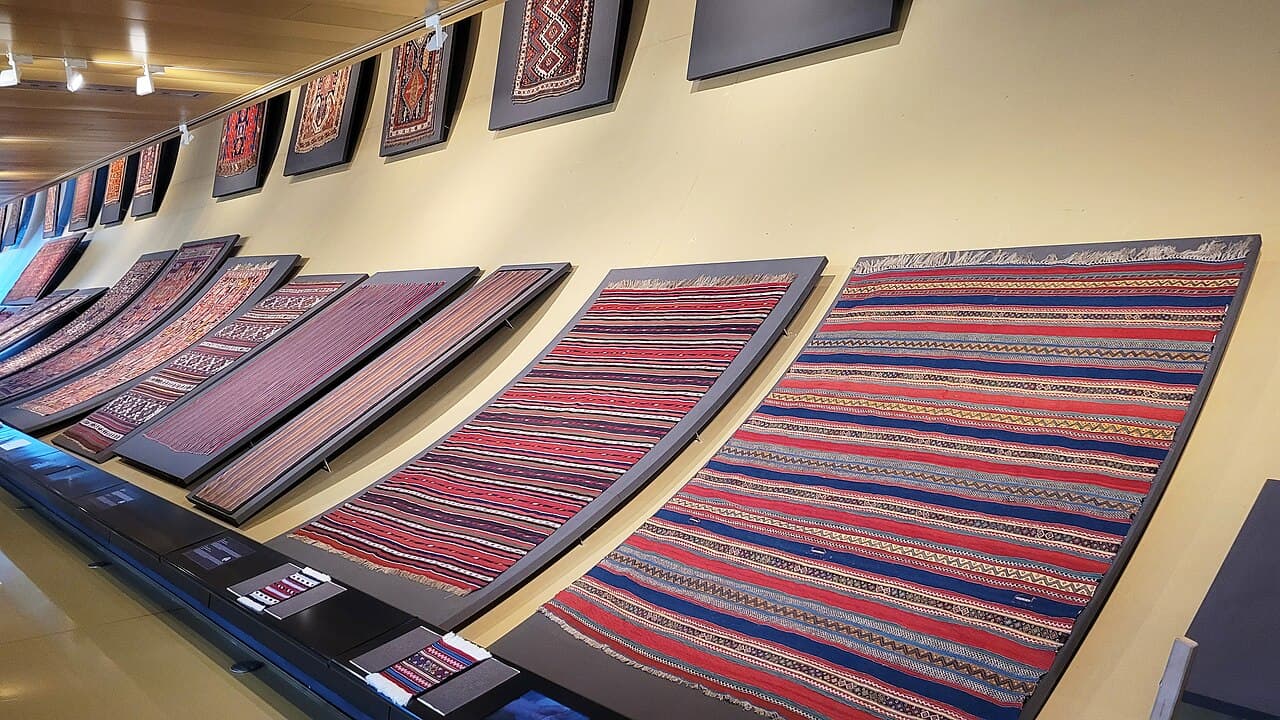
UNESCO's description distinguishes knotted pile carpets from pileless textiles whose patterns emerge through interlacing warp and weft. That structural difference determines surface, thickness and the kinds of visual effects a weaver can create. Pattern is built into the fabric rather than applied afterward.
Stand far enough away to register the complete composition, then move only as close as the display permits to study its construction. The shift between overall order and individual knots or interlacings is the central marvel. Beginning with method also prevents design from floating free of labour, material and learned skill.
Sources: UNESCO Intangible Cultural Heritage; Azerbaijan Tourism Board02
Material changes what colour can do
UNESCO records wool, cotton and silk among traditional materials and notes the use of dyes prepared from plants. Fibres differ in sheen, strength and fineness, so two similarly coloured designs may behave differently under light or support different levels of detail.
Instead of trying to name every dye from sight, observe relationships: a dark outline sharpening a pale form, a limited palette producing rhythm, or a bright accent interrupting repetition. Museum labels should lead any claim about a specific object's materials or date. Visual confidence is not a substitute for conservation and catalogue evidence.
Sources: UNESCO Intangible Cultural Heritage; Heydar Aliyev Foundation03
Follow field, border and rhythm
A carpet's centre and borders perform different work. The field may organise medallions, repeated figures or a more continuous lattice; multiple borders can frame that activity with alternating widths and rhythms. Notice whether the eye is pulled inward, sent along an axis or kept moving across a repeated surface.
Then compare density and scale. A large motif repeated a few times produces a different pace from many small units packed tightly together. These formal observations remain valid even when you cannot identify a motif. They make looking precise without inventing a universal dictionary that the museum's own information does not support.
Sources: UNESCO Intangible Cultural Heritage; Azerbaijan Tourism Board04
Use regional schools as coordinates
The official museum overview presents carpets from seven regional schools, giving visitors a framework for comparing traditions associated with different parts of Azerbaijan. Geography can help explain recurring formats, palettes and design families, especially when several labelled examples appear near one another.
A school name is not a mechanical rule. Individual date, workshop, maker, purpose and movement of designs all matter. Read the label, compare multiple works from the same grouping, and only then compare it with another region. One carpet cannot carry the entire identity of a city or district.
Sources: Azerbaijan Tourism Board; Official Website of the President of Azerbaijan06
The museum building makes an argument
The current museum building opened in 2014 to a design associated with Franz Janz and takes the form of a rolled carpet. That literal exterior symbol announces the collection from the boulevard before a visitor sees a single textile.
Inside, the more important curatorial task is to unfold difference: historical periods, techniques, regions and object types. Compare the building's single bold metaphor with the collection's refusal to be one thing. The contrast is useful—an instantly legible icon outside, a complex and varied tradition within.
Sources: Azerbaijan Tourism Board; Official Website of the President of Azerbaijan; Heydar Aliyev Foundation07
A five-question looking routine
For any displayed carpet, ask five questions in order: Is it pile or pileless? What materials does the label identify? How do field and borders divide the surface? Which regional and historical context is documented? What evidence suggests domestic, ceremonial or other use? The order moves from visible structure toward interpretation.
End by choosing two works that differ sharply and explaining the contrast in plain language. That small exercise produces a more durable memory than photographing every gallery. If a demonstration or temporary display is important to you, verify the current programme with the museum; historical descriptions do not guarantee that a particular activity is operating.
- Identify construction before motif.
- Use the label for material, date and provenance.
- Compare several examples before generalising about a regional school.
- Connect the textile to makers, transmission and social use.
- Describe what you can see before proposing what it means.
Useful answers
Reader questions
What is the basic difference between pile and pileless carpets?
Pile carpets build a raised surface through knots tied around warp threads, while pileless textiles create pattern through interlaced warp and weft without that knotted pile. The difference affects texture, structure and visual detail.
Sources: UNESCO Intangible Cultural HeritageCan every Azerbaijani carpet motif be translated into one meaning?
No reliable universal key should be imposed on every object. Begin with the museum label, documented provenance, structure and comparison with related works. Similar forms may change meaning across region, period and context.
Sources: Azerbaijan Tourism Board; UNESCO Intangible Cultural HeritageWhy is carpet weaving intangible heritage if carpets are physical objects?
UNESCO's inscription concerns the knowledge and practice of weaving, including techniques, transmission and social roles. The textile is tangible, but the learned process and community relationships that produce and use it are living heritage.
Sources: UNESCO Intangible Cultural HeritageWhat else does Baku's Carpet Museum collect?
Official descriptions include costume, embroidery, jewellery, metalwork, ceramics and other decorative arts alongside carpets. These collections help place textile design within a wider material and social world.
Sources: Azerbaijan Tourism Board; Official Website of the President of Azerbaijan; Heydar Aliyev FoundationRead the evidence
Sources and further reading
These sources support the relevant sections above. Plans and comparisons are editorial suggestions. Check operators for current arrangements.
- Traditional Art of Azerbaijani Carpet Weaving in the Republic of Azerbaijan ↗UNESCO Intangible Cultural Heritage · Research date 14 September 2026
2010 inscription, pile and pileless techniques, materials, transmission and social roles.
- Visit Baku's Carpet Museum ↗Azerbaijan Tourism Board · Research date 14 September 2026
Museum history, collections, regional schools, building and interpretation.
- Opening of the New Building of the Azerbaijani Carpet Museum ↗Official Website of the President of Azerbaijan · Research date 14 September 2026
Building opening, architect, rolled-carpet form and collection categories.
- The Azerbaijan Carpet Museum ↗Heydar Aliyev Foundation · Research date 14 September 2026
Museum functions, collection breadth, library and weaving-centre context.
05
A carpet moves through social life
UNESCO's intangible-heritage record places carpet weaving in family and community transmission. Skills pass through observation and practice, and finished textiles participate in domestic and ceremonial settings. The tradition therefore includes relationships, knowledge and use—not only valuable objects preserved after completion.
This perspective changes a museum encounter. Wear, repair or an unusual dimension may raise questions about how a piece lived before display. Companion objects such as costume and jewellery also stop the carpet from being isolated as a flat artwork. They situate colour, ornament and skilled making within a broader material culture.
Sources: UNESCO Intangible Cultural Heritage; Azerbaijan Tourism Board; Heydar Aliyev Foundation