Connect this guide with the rest of your visit in the Baku trip planner. Read how the research is made and what its sources establish.
At a glance
Start here
- Treat Gobustan as a cultural landscape, not a collection of isolated carvings.
- Use the museum or official interpretation before walking among the rocks.
- Look for recurring subjects—people, animals, boats, dances and hunts—without inventing meanings.
- Keep nearby mud volcanoes separate in your planning because they are not part of the rock-art visit itself.
01
Understand why Gobustan matters
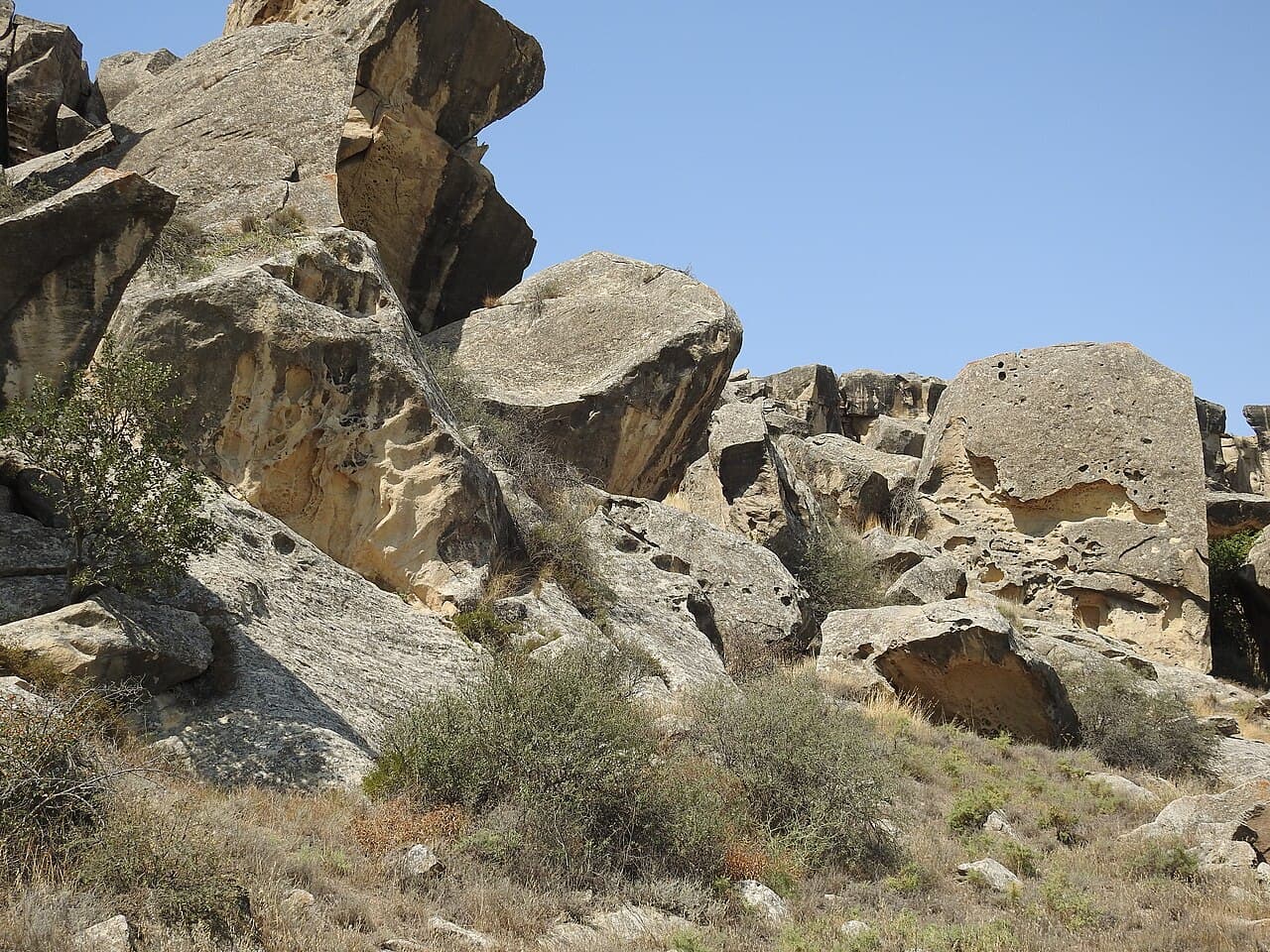
UNESCO describes more than 6,000 rock engravings across three areas of a rocky plateau, alongside traces of caves, settlements and burials. Together they document a very long sequence of human presence, with evidence spanning roughly 40,000 years and continuing from the Upper Palaeolithic into later historical periods.
The key phrase is cultural landscape. The pictures cannot be separated from the shelters, routes, changing shoreline and resources that made life here possible. Instead of asking only which carving is oldest, ask why people repeatedly returned to these rocks and what changes in subjects, scale and technique might reveal. That broader question keeps the outing grounded when precise interpretations remain contested.
Sources: UNESCO World Heritage Centre; UNESCO World Heritage Centre02
Plan it as a dedicated trip from Baku
Azerbaijan's official tourism site places the reserve about 60 kilometres south of Baku among the Boyukdash, Kichikdash and Jingirdagh areas. That is close enough for an out-and-back excursion, but distant enough that transport should be settled before departure rather than improvised after a city morning runs long.
Give the reserve the main share of the outing. Confirm current entry arrangements and the scope of any booked transfer directly with the reserve or provider, because this guide does not promise a particular timetable, road condition or included stop. If the day has limited flexibility, protect the museum-and-rock-art sequence first and treat everything else as expendable.
Sources: Azerbaijan Tourism Board; UNESCO World Heritage Centre03
Use interpretation before the open-air site
The World Heritage nomination describes the museum as an interpretation centre for the reserve. Starting there gives names and chronology to forms that can otherwise look like faint scratches on exposed stone. It also introduces the three landscape components and the archaeological evidence beyond the engravings.
Do not try to memorise every period. Choose a few visual questions to carry outside: how are human bodies simplified, which animals recur, when do boats appear, and how does one image overlap another? A short interpretive foundation turns the walk into active looking. If the museum's current operation differs from expectations, rely on official on-site material and marked routes rather than a cached travel description.
Sources: UNESCO World Heritage Centre; UNESCO World Heritage Centre04
Read subjects without forcing a story
Official descriptions identify people, animals, boats, warriors, dances, hunting scenes and camel caravans among Gobustan's imagery. Those subjects suggest changing lifeways, but a recognisable outline is not a complete explanation. A circle of figures may invite a ritual reading, for example, without proving every detail of who participated or why.
Build observations in layers. First record what is visibly present; next notice placement, scale and nearby figures; only then consult an interpretation. This separates evidence from assumption. It also makes less spectacular panels worthwhile, because weathering, superimposition and position on the rock face can matter as much as a bold animal silhouette.
Sources: Azerbaijan Tourism Board; UNESCO World Heritage Centre05
Notice more than petroglyphs
The reserve preserves archaeological traces of habitation and burial as well as engraved panels. Official visitor material also draws attention to a Roman inscription and the gaval dash, a resonant stone associated with a distinctive sound. These features belong to different moments and should not be compressed into one vague prehistoric scene.
Use the terrain to connect them carefully. Rock shelters explain where occupation evidence survives; wide views reveal the plateaus and the landscape beyond; later inscriptions show that passage through the area continued. Stay with marked visitor routes and barriers. The nomination documents protective routing around panels, so a rope is conservation infrastructure rather than an obstacle to a better photograph.
Sources: Azerbaijan Tourism Board; UNESCO World Heritage Centre; Azerbaijan Tourism Board06
Handle the chronology carefully
Official summaries do not always use the same date range. UNESCO's World Heritage record speaks of evidence covering about 40,000 years, while the tourism page gives a narrower range for the petroglyphs it describes. These statements may refer to different evidence or dating frameworks, but a general visitor should not pretend that they are interchangeable.
The responsible formulation is that Gobustan preserves more than 6,000 engravings within a landscape showing human presence across tens of millennia. When a label assigns a particular panel to a period, follow that panel-specific interpretation. Avoid transferring its date to neighbouring images simply because they share a rock surface.
Sources: UNESCO World Heritage Centre; Azerbaijan Tourism Board07
Keep optional add-ons genuinely optional
Mud volcanoes are frequently paired with Gobustan in excursion marketing, and the official tourism page describes them as a separate attraction a short drive from the reserve. They are not another gallery within the World Heritage property. Reaching a separate natural site can involve different logistics that must be confirmed for the actual day.
Add one only if the transfer, current local access and time budget are explicit. Otherwise return to Baku after the reserve with a coherent understanding of the rock art rather than a hurried collection of unrelated stops. A focused excursion also leaves room to review photographs against the museum's chronology while the details are still fresh.
- Confirm transport and current reserve information before departure.
- Begin with official interpretation when it is available.
- Follow marked routes and observe panels from designated positions.
- Separate documented subjects from speculative meanings.
- Treat mud volcanoes as a separate, conditional extension.
Useful answers
Reader questions
Is Gobustan inside central Baku?
No. The official tourism description places the reserve about 60 kilometres south of Baku. It works as a dedicated excursion, so transport and current visitor arrangements should be confirmed before leaving the city.
Sources: Azerbaijan Tourism BoardHow many rock engravings are at Gobustan?
UNESCO and Azerbaijan's tourism authority describe more than 6,000 engravings. They are distributed within a wider landscape that also includes settlement, shelter and burial evidence, which is why the site should not be understood as a single rock panel.
Sources: UNESCO World Heritage Centre; Azerbaijan Tourism BoardAre Gobustan's mud volcanoes part of the UNESCO rock-art site?
No. The tourism authority presents mud volcanoes as a separate nearby attraction. Do not assume a rock-art ticket or transfer includes them, and verify current logistics independently if you want to add that stop.
Sources: Azerbaijan Tourism Board; UNESCO World Heritage CentreWhy follow the designated route if other rocks look reachable?
Visitor routing is part of protecting exposed panels and their archaeological setting. The World Heritage nomination discusses barriers and controlled circulation around engravings. Remaining on the marked route helps preserve the evidence and keeps observation within the reserve's managed areas.
Sources: UNESCO World Heritage CentreRead the evidence
Sources and further reading
These sources support the relevant sections above. Plans and comparisons are editorial suggestions. Check operators for current arrangements.
- Gobustan Rock Art Cultural Landscape ↗UNESCO World Heritage Centre · Research date 14 September 2026
World Heritage scope, engraving count, archaeology, chronology and significance.
- Gobustan Rock Art Cultural Landscape Nomination File ↗UNESCO World Heritage Centre · Research date 14 September 2026
Landscape components, museum interpretation and conservation-oriented visitor routing.
- Discover Gobustan's Ancient Rock Art ↗Azerbaijan Tourism Board · Research date 14 September 2026
Location, depicted subjects, Roman inscription, gaval dash and separate mud-volcano context.
- Gobustan Rock Art Cultural Landscape - Maps ↗UNESCO World Heritage Centre · Research date 14 September 2026
Mapped World Heritage property and component boundaries.
- Six Cultural Tours in Azerbaijan ↗Azerbaijan Tourism Board · Research date 14 September 2026
Official visitor interpretation of Gobustan's reserve landscape and cultural features.