Connect this guide with the rest of your visit in the Baku trip planner. Read how the research is made and what its sources establish.
At a glance
Start here
- Ateshgah is an architectural and pilgrimage site; Yanardag is a reserve focused on a natural flame.
- Read Ateshgah's courtyard, altar and cells as a connected complex shaped in the seventeenth and eighteenth centuries.
- Recognise Ateshgah's UNESCO Tentative List status without calling it an inscribed World Heritage Site.
- Verify current entry and transport details with official reserve channels rather than relying on static travel copy.
01
Separate the two fire stories
The official tourism authority pairs Ateshgah and Yanardag because both help explain the Absheron Peninsula's association with fire. Their evidence is not the same. Ateshgah consists of masonry buildings organised around an altar, while Yanardag's defining feature is flame issuing from a hillside.
Begin the day with that distinction in mind. At the temple, ask who used the rooms and how ritual space was organised. At Yanardag, focus on geology, landscape and the modern presentation of a long-observed natural phenomenon. The comparison becomes meaningful precisely because the sites should not be narrated as duplicates.
Sources: Azerbaijan Tourism Board; UNESCO World Heritage Centre; Official Website of the President of Azerbaijan02
Read Ateshgah from courtyard to cell
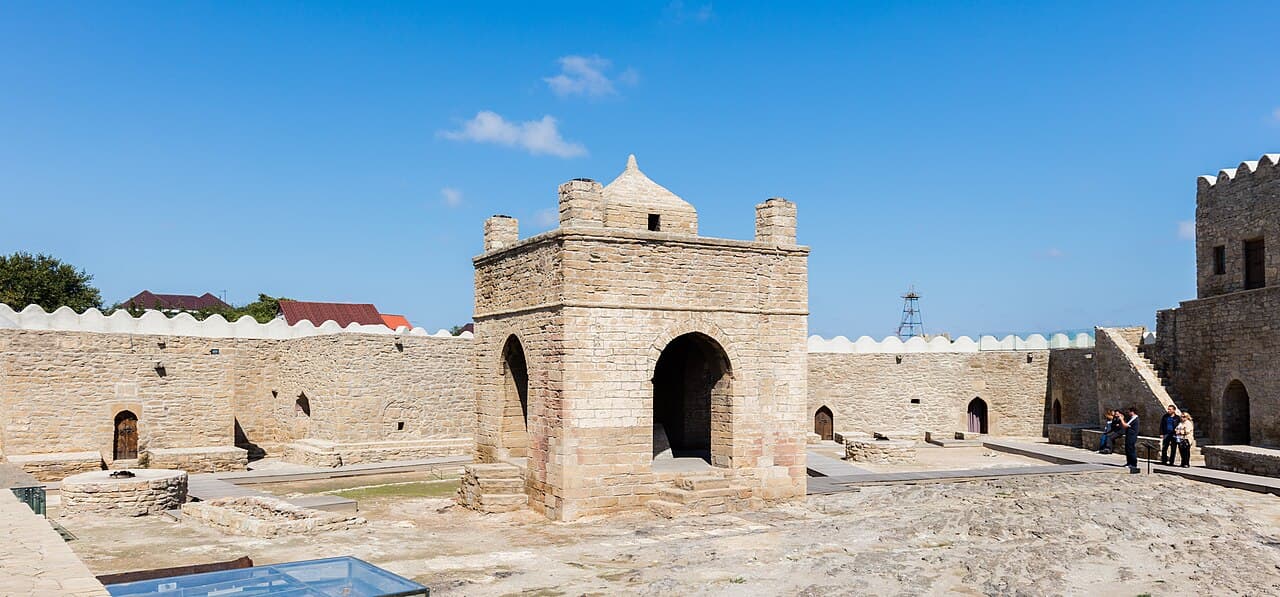
UNESCO's Tentative List record describes a pentagonal enclosure with a central, four-arched altar. Official restoration documentation also identifies a caravanserai and 26 cells around the complex. That arrangement makes circulation as important as the freestanding altar seen in most photographs.
Walk the perimeter conceptually before concentrating on exhibits: an enclosed court gathers worshippers, individual cells imply longer stays, and inscriptions connect the site to people who travelled considerable distances. The architecture communicates an active community rather than an isolated flame shrine. Current presentation may route visitors differently, so use on-site interpretation for the exact sequence.
Sources: UNESCO World Heritage Centre; Official Website of the President of Azerbaijan03
Place pilgrimage beside trade
The surviving complex took shape mainly in the seventeenth and eighteenth centuries. UNESCO's submission connects its development with pilgrims and merchants arriving through trading networks, including people associated with Multan. The presidential restoration account records a Sanskrit inscription among the site's evidence.
Those details argue against an oversimplified label. Ateshgah is often introduced through broad references to fire worship, Hinduism or Zoroastrianism, but the buildings and inscriptions reflect movement and layered use. Follow the terminology on authoritative site interpretation, distinguish the documented later complex from older regional traditions, and avoid assigning every feature to one undifferentiated faith.
Sources: UNESCO World Heritage Centre; Official Website of the President of Azerbaijan; Azerbaijan Tourism Board04
Get the UNESCO status right
Ateshgah appears on Azerbaijan's UNESCO Tentative List submission under the Surakhany name. A Tentative List identifies a property a state may consider nominating; it is not the same as inscription on the World Heritage List. That distinction matters in any caption, tour note or social post.
One Azerbaijani official event page uses stronger World Heritage wording, but UNESCO's own current record is the controlling source for UNESCO status. The careful description is therefore an official historical-architectural reserve and UNESCO Tentative List property. Its value does not require an upgraded label.
Sources: UNESCO World Heritage Centre; Official Website of the President of Azerbaijan05
Approach Yanardag as a landscape phenomenon
Yanardag presents fire without the architectural enclosure of Ateshgah. The tourism authority describes a natural flame on the Absheron Peninsula, while the official 2019 redevelopment account identifies it as a state historical-cultural and natural reserve. Museum and interpretation facilities were incorporated into that redevelopment.
The flame itself can appear visually modest beside Baku's monumental architecture. Its significance lies in persistence and setting rather than height. Give time to the explanatory material and the relationship between the burning slope and surrounding terrain. Do not infer present conditions, viewing distance or operating arrangements from photographs taken at an unknown date.
Sources: Azerbaijan Tourism Board; Official Website of the President of Azerbaijan06
Compare evidence, not just flames
After both sites, list what each one can actually prove. Ateshgah offers a dated architectural complex, inscriptions, cells and a courtyard plan linked to travellers and worship. Yanardag offers a managed natural reserve centred on a burning geological feature. Neither alone explains every use of fire in Azerbaijani history or identity.
That evidence-first comparison is more rewarding than repeating a national nickname. It reveals how natural conditions can acquire religious, commercial and cultural meanings, then be interpreted again through museums and tourism. Keep modern symbolism as a final layer rather than using it to rewrite the documented chronology.
Sources: UNESCO World Heritage Centre; Official Website of the President of Azerbaijan; Official Website of the President of Azerbaijan07
Use a flexible planning framework
If visiting both, preserve enough time at Ateshgah to understand the whole enclosure and enough at Yanardag to read the interpretation rather than only photograph the flame. The order is less important than maintaining the conceptual contrast. Combining them is sensible; making the second a rushed proof-of-attendance stop is not.
Check each reserve's current official information shortly before travel, and confirm exactly what a driver or tour includes. This article intentionally excludes hours, prices and access promises because they can change. If only one site fits, choose Ateshgah for architecture and transregional pilgrimage history, or Yanardag for the natural-fire landscape and its modern reserve presentation.
- At Ateshgah, prioritise the courtyard plan, altar, cells and inscriptions.
- At Yanardag, connect the flame to the terrain and interpretive material.
- Describe Ateshgah as a Tentative List property, not an inscribed UNESCO site.
- Confirm live logistics directly before the excursion.
Useful answers
Reader questions
Are Ateshgah and Yanardag the same type of attraction?
No. Ateshgah is a built temple and caravanserai complex organised around a central altar. Yanardag is a natural reserve centred on flame emerging from a hillside. Pairing them works best when that difference stays explicit.
Sources: UNESCO World Heritage Centre; Official Website of the President of AzerbaijanIs Ateshgah a UNESCO World Heritage Site?
It is on Azerbaijan's UNESCO Tentative List, which is not the same as World Heritage inscription. Use the Tentative List description unless UNESCO's official status changes in the future.
Sources: UNESCO World Heritage CentreWas Ateshgah used by only one religious community?
The documented complex reflects pilgrims and merchants moving through long-distance networks, with inscriptions and interpretations connected to the Indian subcontinent as well as the region's wider fire traditions. It is safer to follow evidence for particular spaces than impose one label on its entire history.
Sources: UNESCO World Heritage Centre; Official Website of the President of Azerbaijan; Azerbaijan Tourism BoardWhere can I verify current visitor arrangements?
Consult the official reserve or State Tourism Agency channels shortly before visiting, and ask any transport provider to state its inclusions. Historical pages establish the sites' character but do not guarantee current hours, prices or visitor routing.
Sources: Azerbaijan Tourism BoardRead the evidence
Sources and further reading
These sources support the relevant sections above. Plans and comparisons are editorial suggestions. Check operators for current arrangements.
- Sites of Ancient Fire Leave a Burning Legacy ↗Azerbaijan Tourism Board · Research date 14 September 2026
Official pairing and broad distinction between Ateshgah and Yanardag.
- Surakhany, Atashgyakh (Fire-worshippers, Temple-museum at Surakhany), Baku ↗UNESCO World Heritage Centre · Research date 14 September 2026
Tentative List status, architectural plan, chronology and pilgrimage-trade context.
- Ilham Aliyev Reviewed Atashgah Temple After Restoration and Reconstruction ↗Official Website of the President of Azerbaijan · Research date 14 September 2026
Reserve status, cells, caravanserai, altar, inscriptions and museum presentation.
- Ilham Aliyev Inaugurated Yanardag Reserve After Major Overhaul ↗Official Website of the President of Azerbaijan · Research date 14 September 2026
Yanardag's reserve status and interpretive redevelopment.